About Me
Research Interests:
I am working on advancing our understanding of the atmospheres of hot Jupiter exoplanets. My research explores what ground- and space-based observations
can reveal about their composition, physical and chemical processes, and atmospheric dynamics. To this end, I analyze observational data from telescopes
and develop forward models for atmospheric retrievals, with a particular emphasis on incorporating 3D effects.
Publications: ADS link
Education:
- Ongoing:
- PhD in Astronomy, Atmospheric Physics of Exoplanets Department, Max Planck Institute for Astronomy, Heidelberg, Germany
- 10/2021 - 11/2024:
- MSc in Physics and Astronomy, Heidelberg University, Germany
- Thesis title: "Reanalysis of the HST/WFC3 transmission spectrum and atmospheric characterisation of HD 209458b“
- 10/2018 - 08/2021:
- BSc in Physics, Heidelberg University, Germany
- Thesis title: “Observation and analysis of exoplanet transits with the 70 cm telescope at the State Observatory Heidelberg”
Conferences, Workshops, Internships:
- 11/2025:
- Signal in the Noise, Schloss Ringberg, Germany
- Workshop focused on overcoming instrumental and astrophysical challenges when characterising transiting exoplanet atmospheres
- 07/2025:
- DPG Summer School, Bad Honnef, Germany
- Topic: A New Era in Exoplanet Atmosphere Observation and Characterisation
- 07/2025:
- Exoclimes VII, Montréal, Canada
- Poster presentation about my work on HD 209458b
- 07/2024:
- ESA Alpbach Summer School, Alpbach, Austria
- Topic: Designing a concept for a space mission to the outer planets of the Solar System and their moons
- 10/2017 - 12/2017:
- Internship, Astronomical Institute of the University of Bern, Switzerland
- Topic: Evaluation of GNSS-satellite orbit data using self-developed Python scripts
Research
Osiris revisited: Confirming a solar metallicity and low C/O in HD 209458b
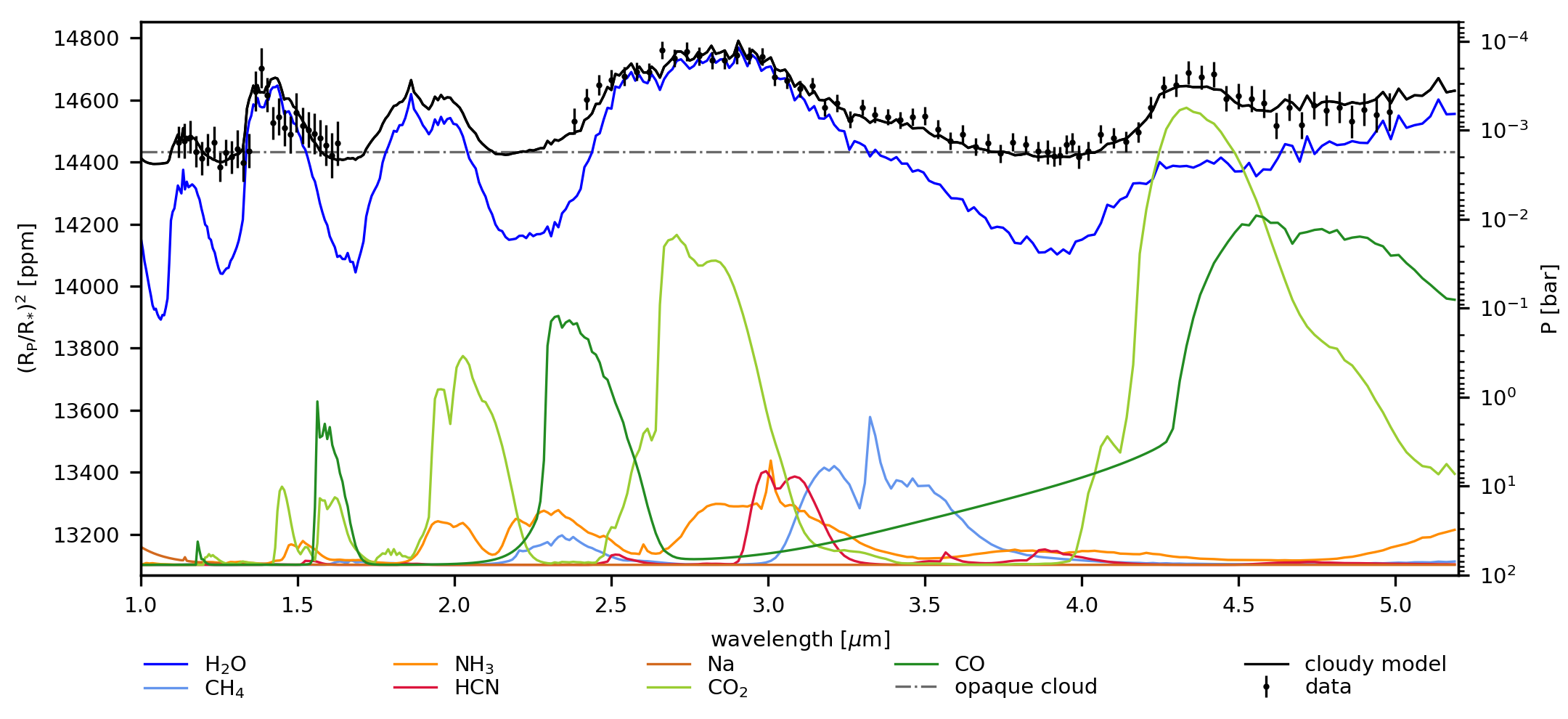 Transmission spectrum of HD 209458b with opacity contributions of several absorbing species.
HD 209458b is the prototypical hot Jupiter exoplanet and one of the best targets available for
precise atmosphere characterisation. Using data from the Hubble Space Telescope and the James Webb Space Telescope, we studied the atmospheric properties in unprecedented detail.
A new data reduction and analysis of the original HST/WFC3 spectrum, accounting for the wavelength dependence of the instrument systematics allowed us to precisely and robustly measure
the much-debated H2O abundance in HD 209458b’s atmosphere. We combined the newly reduced spectrum with archival JWST/NIRCam data and ran free chemistry atmospheric retrievals over the
1.0 − 5.1 μm wavelength range, covering possible features of multiple absorbing species, including CO2, CO, CH4, NH3, HCN, Na, SO2, and H2S. We detected
H2O and CO2 robustly at above 7σ significance, and found a 3.6σ preference for cloudy models compared to a clear atmosphere. We used Bayesian model averaging to account for a
range of different assumptions about the cloud properties, resulting in a H2O volume mixing ratio of
× solar and a CO2 abundance of
× solar. Both results are consistent with solar values and comparable to predictions from the VULCAN
1D photochemistry model. Combining these values with a prior on the CO abundance from ground-based measurements, we derived
an overall atmospheric composition comparable to solar metallicity of
and very low C/O of
with a 3σ upper limit of . This indicates a strong enrichment in oxygen and depletion in carbon during HD 209458b’s formation.
Have a look at the full paper.
pRT-orange: A new petitRADTRANS package to retrieve the 3D structure of exoplanet atmospheres
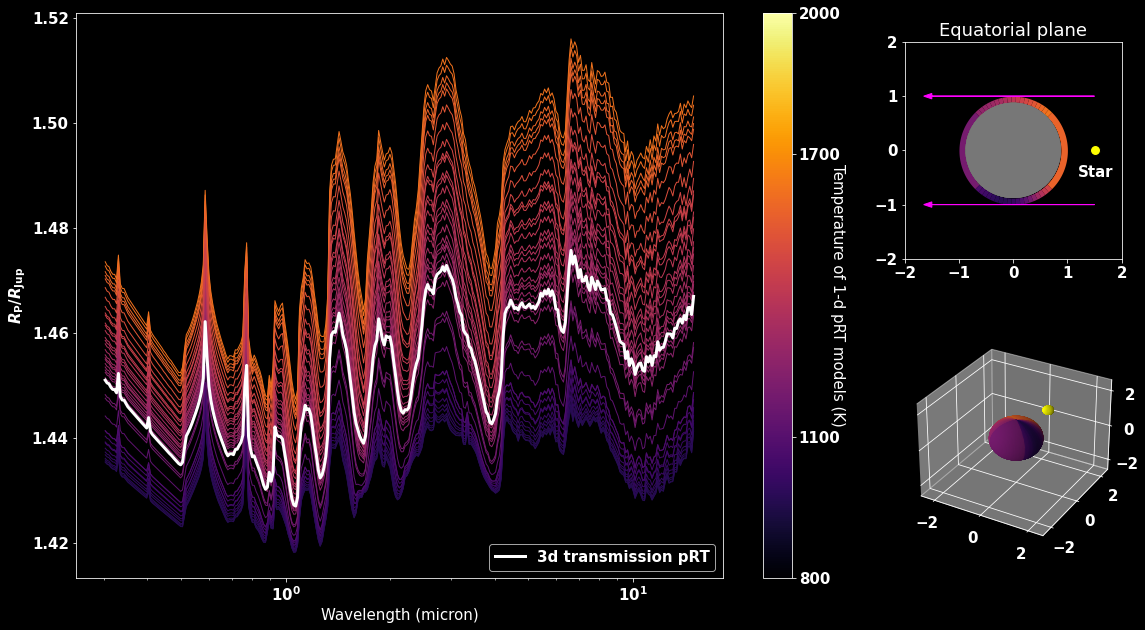 Comparison of 1D isothermal models at different temperatures of 20 regions around the planet with a 3D calculation of the spectrum.
Retrievals are a powerful tool for extracting information about the chemical composition, structure, and dynamics of exoplanet atmospheres.
Although exoplanets are inherently three-dimensional in their nature, most retrieval codes treat the planetary atmosphere in 1D to simplify the models and keep computation times manageable.
This treatment induces biases in the results, especially for hot exoplanets which have significant differences in temperature and chemistry between their day- and nightsides.
In addition, transmission spectroscopy probes the terminator region of a planet, which is the most heterogeneous region in the atmosphere, with large gradients in temperature and composition.
To account for these biases and enable more accurate forward modelling and retrievals of hot exoplanet atmospheres, we develop pRT-orange, a new package for the widely used petitRADTRANS code
(Mollière et al., 2019; Nasedkin et al., 2024; Blain et al. 2024).
pRT-orange splits the modelled atmosphere into several longitudinal segments with distinct atmospheric properties such as temperature, chemistry, and cloud treatment.
The photon path is traced through the segments, taking the full 3D structure into account. In addition, Doppler shifts and line broadening due to planetary rotation and winds can be included.
Our package enables more detailed and accurate retrieval of atmospheric properties, while keeping computation times affordable. pRT-orange will be a powerful tool for interpreting signatures of three-dimensionality, both in current JWST data and at higher resolution in the ELT era.
Contact
Email: bachmann (at) mpia.de